Tuesday, 2 February 2016

Beginning 2016

If you've been following my erratic posting at all, you'll realise that I've been playing catch up. I've promised myself I won't let this happen again and that I'll document my work as I go rather than waiting for a break and trying to get it all up to date after the fact! 
I apologise for this poor practice and promise to do better.

We concluded 2015 with very pleasing and promising results. Pleasing in that it made a year of hard work on the part of our whole team very rewarding, and promising because it case proved stuff we can build on and share with a great deal of confidence. It helped enormously that our Researchers, Woolf Fisher Research Centre corroborated our results and supported many of our hypotheses.

This gave us confidence when planning our focus for 2016, which I've shared with staff parents, Board, many visitors to our school and now belated with you.

My inquiry in 2016 is into the challenge of getting equity of acceleration for every child in every class in our school. I then want to share this process with others.



Friday, 11 December 2015

Where did we get to in 2015?

Toward the end of 2015 we waited with baited breath to see our learners results from November testing to find out whether the things we been discussing and debating in this blog and the work we'd done as a staff, actually worked.

Like all industries we have good years and hard years, and we were really hoping this would be a 'good one'.
You can imagine our relief as the results came in, we prepared reports for parents, our community and the NZ Ministry of Education, and we could see that together, we had done well.

As we do every year, we met with our parents in the School Hall and shared the good news as well as consulting about how we would do things in 2016.
Here's a summary of that report.
I want to conclude this post at the end of 2105, having thanked our learning partners in my report above, by acknowledging a great leader, educator, mentor and friend, our Kaumatua Ihaka Samuels who passed away this year.
You will have seen and heard, if you watched my report, the landing of Mālama Honua at Pt England Beach, in March this year.
The ancient wisdom that was imparted to us, which enabled this landing, the approval of the name Manaiakalani itself, the true story of Maui Tiki Tiki ā Taranga, were taught us by this faithful friend, brother, father and elder.
Kia ora Ihaka. You've helped us succeed. You taught us to tie our waka to the highest star and not a glow worm.
To mother Mary, the children and grandchildren who are still with us, we acknowledge both the loss and the legacy.
Kia ora tatou.


Friday, 23 October 2015

So where are we up to now?

This post is a break in the discussion about Re-Tooling School and practice change and is instead a progress report of how this is playing out at Pt England over time. This report takes the form of a presentation to parents about how they can engage with the learning of their tamariki


Monday, 31 August 2015

The Quest for Effective Teacher Practice with Sanity in a Digital Learning Environment

As we continue to look for the affordances that produce accelerated learning outcomes in our learners, we become more precise in the identification of the items that make a difference.
We are assisted in this process by our Research Partners from the Woolf Fisher Research Centre of the University of Auckland.

The identification of the 'change making' items and the 'topography' of the classrooms in which they are most significantly occurring produces valuable clarity for development and practice change. At the same time this produces significant tension between the 'teaching conscience' -the desire to do as well as humanly possible for our learners and the need for teachers to retain their sanity as they innovate in an environment where the artefacts for the leading of learning all need to be custom built for multiple groups in 3 different subjects.

Just as we discovered during the years of Schooling Improvement, its abundantly obvious that appropriately differentiated small group Direct Instruction is one of the 'Game Changers'. This item of quality teaching is actually no different in the digital age from what it was in the analogue age of teaching. What is different is the affordance of provision to the learner and learning partners outside of the time of direct instruction some notion of direction and focus that is connected to an associated learning activity that can be carried out independently or collaboratively. This notion of the learner and learning partners not always having to wait for, or have the presence the teacher, is an absolutely new affordance and adds significant value to the 'Differentiated, Direct Instruction Game Changer'.

The other significant Game Changer which adds on to the 'Leading of Learning' is this artefact providing a high quality learning activity which links to and consolidates the learning from the Direct Instruction. The more effectively these artefacts are linked and are effective in embedding the learning from the Direct Instruction, the more we see High Cognitive Engagement and accelerated achievement outcomes.

As we pursue this effective, differentiated linkage there is a direct effect on teacher workload, especially at the beginning of this creative journey as almost all of the artefacts for leading or consolidating learning are custom builds. Fortunately the workload reduces as teacher proficiency and efficiency increases and teachers become more effective at creating 'leading of learning' artefacts that can be generically applied across levels within a learning discipline.

The piece in the middle, seen again here below, remains critical in the teacher planing cycle
Screen Shot 2015-06-13 at 4.10.59 pm.png as it is during this phase that all this 'hard graft' of planning and preparing for learning and teaching takes place. 

What this means practically for Pt England School is that as a staff we discuss:


  •  how much differentiation is too much and how much is the right amount
  • how to most effectively link learning activities to direct instruction
  • the balance between generic learning activities and custom builds with level specific WALT focus
I'm happy to report that whole staff is actively engaged in this learning and that we can celebrate huge success, both in implementation and in visible improvement in learning and teaching.

Monday, 3 August 2015

A More Inclusive New Zealand

Last week I had the humbling privilege to meet with passionate New Zealanders at a Treasury Hosted Event entitled 'A More Inclusive New Zealand'. This event was attended by just over 200 people and was an absolutely riveting mixture of 'practitioner narrative', 'executive summary' of NZ research findings and external critique.
It was a marvellous opportunity to link evidence to practice in a cross sector forum. I'm not aware of this being done in New Zealand previously. Well done Treasury!

Rather than rabbit on exhaustively about something that's extremely well covered elsewhere, I urge you to read Gabriel Makhlouf's opening address. Gabriel is the Secretary of the Treasury in NZ and for my offshore readers, for 'Secretary' read Boss! 
It's extremely heartening to live in a country where the 'man in charge of the money' is urging us in this direction!

I would also urge you to visit the More Inclusive NZ site so you get to connect with the thoughts and ideas of people who are contributing to this important conversation in New Zealand, and to the 'Superu' government site which in their own words is encouraging the use of evidence by people across the social sector so that they make better decisions about funding, policies or services to improve the lives of New Zealand's communities, families and whanau. 

My role at this wonderful event was to speak about equity and access for participatory citizenship by affecting change in the compulsory sector of education.
Here's what I had to show and tell:


Friday, 17 July 2015

Planning for Learning as part of ReTooling Schools

Now, back to unpacking that elusive 'Planning for Learning' element we were beginning to examine, prior to supplying a couple of bits of ReTooling history!

Having digitised learning at Pt England using 1:1 iPads in the junior school and 1:1 ChromeBooks from Y4 up, and having made that learning as visible and accessible to learners and their families as is currently possible and appropriate, we see the lens of 'Planning for Learning' as an imperative for bringing practice change in respect of the practice items that bring about accelerated learning opportunities.

To get consistent acceleration in the ‘3 R’s’ in Primary School and  NCEA at Secondary School in the Learn, Create, Share digital paradigm we need to change teacher practice in respect of some defined learning @ teaching activities. 
Simply put, unless teachers plan for practice change in their mid - short term planning the change will not occur and will certainly not be sustainably embedded.

If we're planning to apply the affordances of new technologies to gaining shift in reading, keeping in mind elements of the new paradigm we wish to see present in the delivery or learning experience, we will need to see very deliberate and 'visible' planning for the items listed in the bullet points above.
If we hope for the practices to be embedded and sustained they will need to be collaborative as this significantly reduces the risk of teachers receiving professional development and then going back to class, shutting the door and doing what they always did.

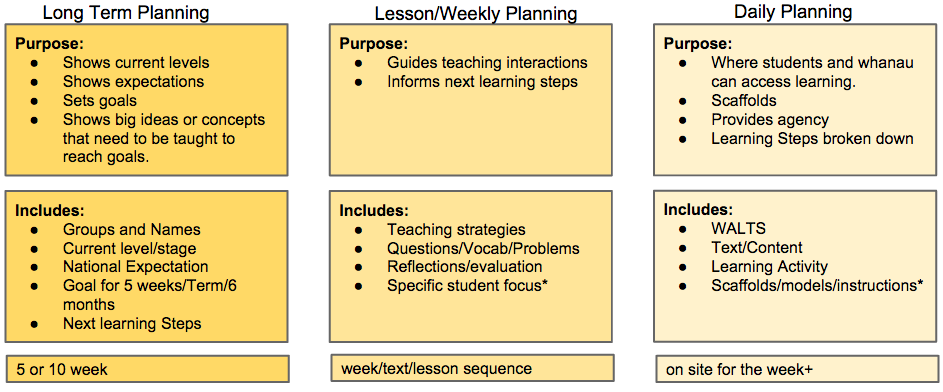
I'm indebted to Juanita Garden, one of the gifted Associate Principals I work with for her representation of what this planning for learning dilemma looks like in chart form.
It seemed that as we digitised the delivery of learning and made the long term and weekly planning & leading of learning visible and available to learners and their families, that we lost clarity around the piece in the middle that may currently need to be available only to the teaching faculty as it will be explicit around the needs of an individual learner or a group of learners. We believe the 'piece in the middle looks something like this:

The discussion that then ensued, was around how to optimise this, in a cloud based environment so that our learners received the most informed and specific direct instruction and related individual or collaborative learning experiences that we could possibly deliver. -All this, without the teacher going crazy!

We came up with level specific models which the school faculty navigate to, from the class or group learning page so that its easy for teachers to focus the learning in real time using the same environment that is being used to publicly lead the learning for the learners in that class or group. 
I would certainly invite you to visit any of the Pt England Class Pages that lead learning at this school, but if you would like to visit one logic chain of visible planning through visible learning to visible share-point via public blog, this site is a good one to visit.

One of the great challenges in NZ education is that unless teachers can effectively integrate, something that must be thoughtfully planned for if it is going to be carried out successfully, they will not actually be able to deliver the whole of the curriculum requirement. The NZ Curriculum is designed to be integrated and whole areas will be missed unless it is. The integration requirement for Term 3, 2015 at Pt England School looks something like this. Where the window is our Learn, Create, Share inquiry theme and the items in the window are everything that must be integrated.

If we return to our Practice Change bullet points from earlier in this post;
  • planning for learning and the leading of learning
  • deliberate acts of teaching or direct instruction
  • independent learning activities
  • reflective feedback loops
  • collaborative practice
You can see that successfully planning and integrating the items above and having high quality direct instruction, independent learning activities and powerful reflective feedback loops, would be terribly difficult and even impossible for young teachers unless this is all part of collaborative practice.

In this quest for practice change that applies the affordances of a digital learning environment to enhance accelerated acquisition of the '3R's' we expect to match the public or visible leading of learning with 'private to teacher' specific queue's, with the learner's actual work and finally their published product.
I'm indebted to another of my amazing staff (Matt Goodwin) for this great example of what this could  look like:


Public Leading of Learning for Children & Families


Teacher Notes to guide Direct Instruction


Observation of Direct Instruction


 Items of learner's work visible via the Teacher Dashboard


Actual item of work

Items of work visible to families via the parent portal


Progressional Information available to families


Published work on Learner's Blog


And the desired outcome of all this?
Instead of this........
We get this....


4 Pou (Posts) that support ReTooling

One of the artifacts  I've been particularly asked to supply as part of this discussion of what supports the business of ReTooling School, is this Screen Record that represents a 'summary of learnings' from the Schooling Improvement years.

I promise you this one is much briefer than the last, (only 3 mins v 30 mins) and supplies some key information about the foundations ReTooling actually rests on.